Breaking Netflix’s $82.7B Deal: What It Means for Investors
 Muhammad Faraz
Breaking Netflix’s $82.7B Deal What It Means for Investors
Netflix has won a pyrrhic victory—securing market dominance at the cost of near-term financial health and shareholder returns.
On February 8, 2026, Netflix confirmed its victory in a bidding war against Paramount Skydance to acquire Warner Bros. Discovery for $82.7 billion in an all-cash transaction. This transformative deal grants Netflix an unparalleled content library but comes with significant immediate consequences:
- Financial Strain: With only ~$9 billion in liquidity, Netflix must fund the deal via massive debt issuance or equity dilution.
- Capital Allocation Shift: The company has officially paused its share repurchase program.
- Growth Deceleration: Management issued 2026 revenue growth guidance of 12-14%, a notable slowdown from 2025’s 16% growth.
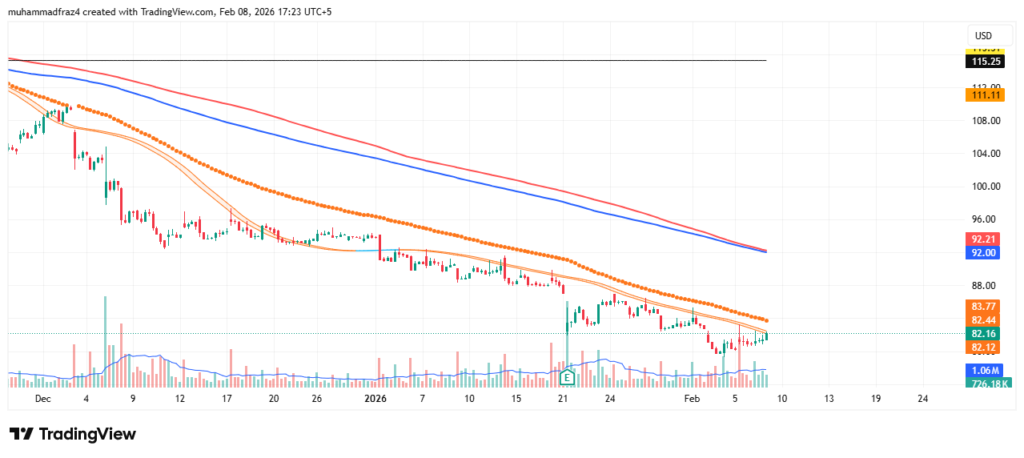
NFLX stock is down 11% over the past month, trades 40% below its 52-week high of $134.12, and has underperformed the S&P 500 over the past year. The stock price reflects deepening investor skepticism about the deal’s cost.
The consensus view is that this acquisition solidifies Netflix’s long-term position as the undisputed leader in global streaming. The Warner Bros. library is seen as a formidable competitive moat, and the doubling of ad-tier revenue in 2026 is highlighted as a key growth pillar.
My Analysis: Interpreting the Move
The market is correctly focusing on the timing and cost, not just the strategic benefit. While the long-term logic is sound, the near-term optics are terrible: slowing organic growth combined with a massively leveraged transaction. The pause in buybacks removes a key support for the stock during this digestion phase. The market is signaling that the price for “dominance” is too high in the current environment, valuing financial discipline and clean execution over empire-building.
Historical Context & Credibility: This pattern is classic “growth at a reasonable price” (GARP) investor alienation. Similar to other mega-acquisitions, the 12-18 month period post-deal is often fraught with integration costs, balance sheet repair, and multiple compression. Netflix’s current P/E of 32, while below its 5-year average of 44, is not cheap enough to discount the coming period of elevated leverage and reduced shareholder returns.
The bullish contrarian case rests on the ad business outperforming and synergy execution being flawless. If Netflix can integrate Warner Bros. smoothly and accelerate ad revenue growth beyond forecasts, the current pessimism could be overdone. However, this is the low-probability scenario for the next year.
What Could Happen Next
NFLX will likely remain under pressure. The pause in buybacks reduces demand for its own shares. Capital may rotate towards streaming competitors with cleaner balance sheets (e.g., Amazon, Apple) or to media companies now perceived as potential acquisition targets. Debt market investors will scrutinize Netflix’s new credit profile closely.
Volatility & Sentiment Shift: Expect elevated volatility in NFLX as the financing details are finalized. The sentiment has shifted from “growth” to “show me,” focusing on debt metrics and integration updates rather than pure subscriber adds.
Forward-Looking Catalysts: Key checkpoints will be:
- Q1 2026 Earnings: Details on deal financing and updated leverage ratios.
- Ad Revenue Metrics: Quarterly reports on the ad-tier growth.
- Credit Rating Announcements: Any downgrade by agencies would be a negative shock.
My Prediction & Price Targets
Based on the synthesis above, I predict that NFLX will trade lower over the next 12 months as the market prices in the costs of the Warner Bros. integration and the period of reduced capital returns to shareholders.
Specific Price Targets & Rationale:
- Primary Target (PT1 – $75): I expect NFLX to test the $75 level. Rationale: This represents a further de-rating towards a P/E in the mid-20s, reflecting its new identity as a higher-leverage, slower-growth corporate entity. It also aligns with a technical re-test of major long-term support.
- Secondary Target (PT2 – $70): A more bearish scenario if integration costs exceed estimates or ad growth disappoints. Rationale: This level would signify a full panic de-rating, approaching the P/E lows of 2022, and would likely represent a long-term buying opportunity for patient investors.
- Key Level to Watch ($79): The recent 52-week low of ~$79.22. A decisive daily close below this level would confirm the bearish breakdown and open the path to PT1 and PT2.
What Could Go Wrong
A daily close above $90 would invalidate the bearish near-term thesis. This would signal that the market has fully discounted the deal’s negatives and is focusing solely on the long-term strategic benefit, likely driven by blowout ad revenue numbers or unexpectedly favorable financing terms.
Key Risk Factors:
- Faster Synergy Realization: Swift cost savings from the merger could boost EPS faster than anticipated.
- Debt Market Accommodation: If Netflix secures financing at remarkably low interest rates, the balance sheet fear would ease.
- Competitive Stumble: Major missteps by competitors (Disney, Amazon) could refocus the market on Netflix’s reinforced dominance.
This is not a trade for the faint of heart. Any long investment should be sized cautiously, acknowledging the high probability of continued volatility and downside pressure. A patient, dollar-cost-averaging approach below $75 may be more prudent than trying to catch a falling knife.
The Bottom Line
Netflix is making a strategically sound but financially painful bet. For the next year, the costs—increased debt, paused buybacks, and integration complexity—will outweigh the strategic benefits in the minds of investors. This will lead to continued underperformance and a lower stock price as the multiple compresses.
Avoid or reduce exposure to NFLX for the next 6-12 months. The stock is in a “show me” period where promises are not enough; it needs to demonstrate flawless execution under a new, leveraged capital structure.
What I’m Watching:
I will monitor two signals most closely:
1) The specific debt/equity mix announced for the deal financing
2) The first post-deal earnings report for any revision to ad-tier or free cash flow guidance.
Chart Source: TradingView
Disclaimer: This commentary represents my personal analysis and opinions. It is for informational purposes only and not financial advice. All investments involve risk, including loss of principal. Conduct your own research and consider your financial situation before making any investment decisions.
About the Author