Buffett Indicator Flashes Rare Signal: Analysis & Market Implications
 Muhammad Faraz
Buffett Indicator Flashes Rare Signal Analysis & Market Implications
A revered market valuation metric has hit a level that has preceded major historical drawdowns.
What Happened
- A key market barometer—the ratio of total U.S. stock market capitalization to the nation’s Gross Domestic Product—climbed to roughly 230% by the close of the third quarter in 2025.
- This places it 2.4 standard deviations above its long-term historical trend line.
- According to historical data, this is only the fourth time in 60 years the metric has breached the two-standard-deviation threshold.
Immediate Market Reaction
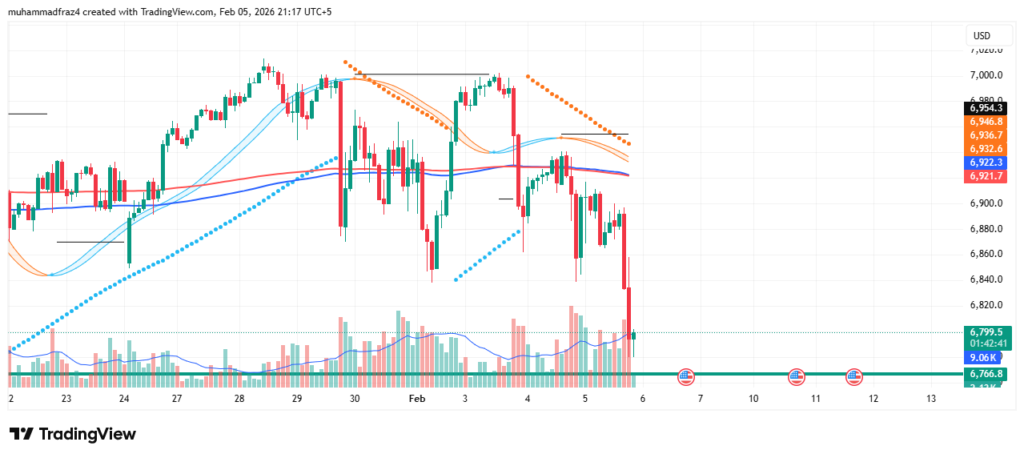
Following its breakthrough above the 7,000 mark in late January 2026, the S&P 500 saw its upward drive falter, with gains quickly eroding. The index faced selling pressure following disappointing earnings reports from major technology firms, highlighting investor sensitivity to high valuations.
The Official Narrative
Financial media and analysts are highlighting the indicator’s warning that U.S. equities are trading at a significant premium to the size of the economy, reviving debates about market sustainability and the payoff from massive AI investments.
Interpreting the Move
While the headline number is alarming, its interpretation requires nuance. The U.S. GDP is a domestic measure, but a significant portion of revenue for S&P 500 constituents is generated internationally. This global footprint arguably justifies a premium. Furthermore, the market’s concentration in a handful of megacap tech stocks exaggerates the metric’s move; a downturn in just a few names can disproportionately impact the total market cap.
The signal’s historical credibility is concerning. The three prior instances (1968, 2000, 2021) were each followed by significant bear markets, with the S&P 500 falling between 25% and 49%. The common thread was a climax in investor euphoria detached from underlying economic or profit growth. The current environment shares similarities, driven by AI exuberance and concentrated leadership.
The contrarian case lies in the “this time is different” argument: unprecedented profitability margins, the transformative potential of AI, and the dominant global position of U.S. corporations could sustain higher valuations. The indicator may be measuring the modern economy with an outdated yardstick.
What Could Happen Next
This environment favors stock-picking over broad index investing. Capital may rotate away from the most extended, profit-light tech names toward sectors with more reasonable valuations relative to their domestic economic footprint, such as energy, industrials, or financials. ETFs like the Invesco S&P 500 Equal Weight ETF (RSP) could outperform the cap-weighted index.
Volatility & Sentiment Shift:
Expect markedly higher volatility. The indicator signals that margin for error is slim. Any earnings miss or guidance reduction from top-heavy index constituents could trigger outsized swings. Overall market sentiment is likely to shift from “buy the dip” to “sell the rally” more quickly.
Forward-Looking Catalysts:
- Q4 2025 & Q1 2026 Earnings: Concrete evidence that AI spending is translating into broad profit growth and expanded margins.
- GDP Growth Reports: Signs of accelerating domestic economic growth could help narrow the indicator’s gap.
- Fed Policy: Any shift toward more restrictive policy would increase discount rates on future earnings, pressuring lofty valuations.
The Forecast
Based on the synthesis above, I predict that the S&P 500 (^GSPC) will face heightened headwinds and enter a period of corrective consolidation over the next quarter, likely testing lower support levels before establishing a new base.
Specific Price Targets & Rationale:
- Primary Target (PT1 – $6,450): The first major support zone. Rationale: This area represents the early-December 2025 consolidation range and the 38.2% Fibonacci retracement from the 2025 low to the 2026 high.
- Secondary Target (PT2 – $6,150): A deeper correction target if selling intensifies. Rationale: This aligns with the 200-day moving average (projected) and the 61.8% Fibonacci retracement level, a classic “healthy correction” depth in a bull market.
- Key Level to Watch ($6,850): Immediate resistance turned support. A sustained break below this level would be the first technical confirmation of weakening momentum and likely trigger a move toward PT1.
What Could Go Wrong
A daily close above 7,250 on sustained volume would invalidate the corrective forecast. This would signal that overwhelming bullish momentum has completely overridden historical valuation warnings, potentially launching a new speculative leg higher.
Key Risk Factors:
- AI Profitability Realized: If megacap tech companies dramatically exceed profit forecasts, justifying their valuations.
- Soft Landing Perfected: A combination of steady GDP growth, falling inflation, and Fed rate cuts could create a “Goldilocks” scenario that supports higher multiples.
- Inflows Continue: Unabated institutional or retail inflows into passive index funds could mechanically propel prices higher despite valuations.
This is not a signal for outright shorting, but a call for caution and risk management. Investors should review portfolio concentration, ensure proper position sizing, and consider hedging strategies. Any new long exposure should be scaled in cautiously, respecting the key support levels outlined.
Final Thoughts
The Buffett Indicator is flashing a statistically rare warning that has credible historical precedence. While structural factors may explain some of the elevation, it coincides with a market showing signs of fatigue at record highs. This sets the stage for increased volatility and a higher probability of a meaningful correction.
Final Takeaway:
Adopt a defensive posture. Use strength to rebalance portfolios, reduce exposure to the most extended sectors, and build cash reserves. The priority should be capital preservation over aggressive speculation.
What I’m Watching:
- The price action around the $6,850 level for confirmation of weakness.
- Breadth metrics – whether a sell-off is concentrated in megacaps or broad-based.
Chart Source: TradingView
Disclaimer: This commentary represents my personal analysis and opinions. It is for informational purposes only and not financial advice. All investments involve risk, including loss of principal. Conduct your own research and consider your financial situation before making any investment decisions.
About the Author