Gold Rebound & Market Moves – Analysis, Outlook, Key Target
 Muhammad Faraz
Gold Rebound & Market Moves – Analysis, Outlook, Key Target
Gold
What Happened:
- On Wednesday, 4 February 2026, gold prices rose for a second consecutive session.
- The move recouped some of the dramatic losses from the prior week, which saw gold drop over 9% last Friday after hitting a record high near $5,595.
- Concurrently, Brent crude oil prices gained slightly amid renewed Middle East tensions after a US-Iranian drone incident in the Arabian Sea.
- The British pound edged higher against the USD and EUR as markets awaited the Bank of England’s interest rate decision.
Immediate Market Reaction:
- Gold Futures (GC=F): +3.4% to $5,102.60/oz.
- Brent Crude (BZ=F): +0.2% to $67.45/barrel.
- GBP/USD (GBPUSD=X): +0.2% to $1.3724.
- The US Dollar Index (DXY) slipped 0.1%.
The Official Narrative
Financial analysts attribute gold’s recovery to “buy-the-dip” sentiment, with major banks calling last week’s sell-off excessive. Geopolitical tensions and a large draw in US oil inventories supported crude. Sterling’s strength is linked to expectations of delayed rate cuts by the Bank of England.
Interpreting the Move
The violent sell-off and subsequent snapback in gold are characteristic of a bull market undergoing a healthy, albeit sharp, correction. The narrative of “excessive” selling is credible given the unchanged macro backdrop: persistent central bank buying, global geopolitical uncertainty, and a long-term trend of portfolio reallocation into real assets. The rebound’s velocity suggests strong underlying institutional demand waiting for better entry points, which last week’s plunge provided. The reaction shows more conviction in the long-term thesis than fear of a trend reversal
Historical Context & Credibility:
Similar sharp corrections have occurred within secular bull markets (e.g., 2008, 2011-2012), often shaking out weak hands before the primary trend resumes. The fundamental drivers—including fiscal sustainability concerns and de-dollarization trends—are structural, not cyclical. This supports the view that the dip was a volatility event within a larger uptrend, not its conclusion.
The bullish consensus is now re-forming very quickly. The risk is that this rapid recovery exhausts short-term buying pressure, leaving gold vulnerable to consolidation or a retest of lower support before making a sustainable run at new highs. The market may be underestimating the potential for a “higher-for-longer” dollar scenario if US economic resilience persists, which could cap the pace of gold’s ascent.
What Could Happen Next
A resumption of gold’s uptrend is directly bullish for gold mining equities (GDX, GDXJ) and associated ETFs, which are often leveraged to the metal’s price. Sustained high prices also benefit silver (SI=F) through correlation. Capital may continue rotating from overvalued tech sectors into the materials and energy complex as a real asset hedge.
Volatility & Sentiment Shift:
Heightened volatility in the commodity space is likely to persist. However, gold’s recovery should help stabilize sentiment across the precious metals complex, shifting focus from “panic selling” back to “strategic accumulation.”
Forward-Looking Catalysts:
- Bank of England Rate Decision (Today): Guidance on the pace of 2026 cuts will be pivotal for GBP and global rate expectations.
- US-Iran Geopolitical Developments: Any escalation affecting Hormuz Strait transit remains a key oil price catalyst.
- Upcoming US CPI Data: The next major inflation print will critically influence real yield calculations and the dollar, thus impacting gold.
My Prediction & Price Targets
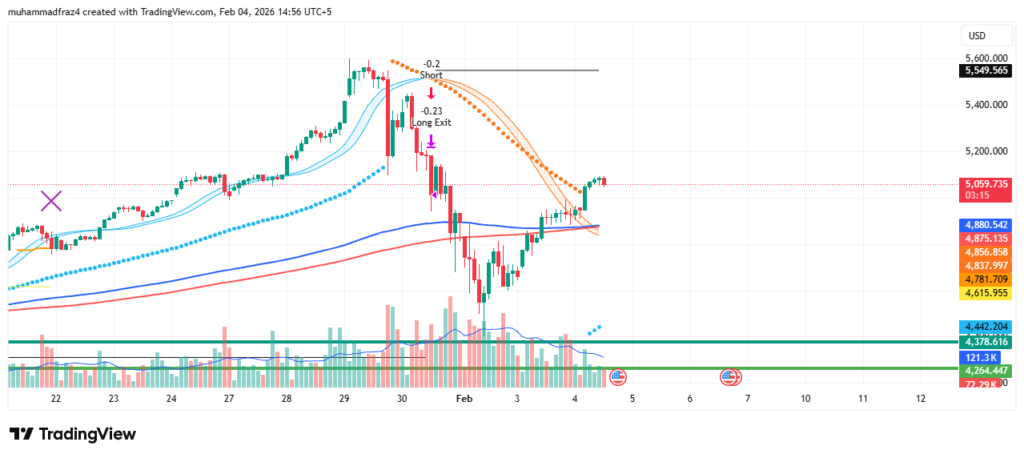
Based on the analysis of structural demand and dip-buying behavior, I predict that Gold (GC=F) will resume its broader bullish trend and target new highs over the next 6-9 months.
Specific Price Targets & Rationale:
- Primary Target (PT1 – $6,200): This aligns with the upper band of analyst forecasts (e.g., UBS) and represents the next major psychological and technical extension of the current bull cycle. Rationale: Convergence of extended bullish channel projection and fundamental bank targets.
- Secondary Target (PT2 – $5,850): An interim resistance level. Rationale: A 50% Fibonacci extension from the recent correction and a zone of prior consolidation.
- Key Level to Watch ($4,950): This recent swing low now constitutes critical support. A sustained move above $5,150 is needed to confirm the rebound has momentum beyond a short-covering bounce.
What Could Go Wrong
A daily close below $4,800 would break the crucial higher-low structure established since late 2025 and suggest a deeper, more prolonged correction is underway, invalidating the immediate bullish resumption thesis.
Key Risk Factors:
- Unexpected Dollar Strength: A rapid shift toward Fed tightening or broad risk-off flows boosting the DXY.
- Rapid De-escalation of Geopolitical Tensions: Reducing safe-haven demand.
- Coordinated Central Bank Selling: An unlikely but market-crushing shift in official sector behavior.
Trading Considerations:
Any long exposure should be sized appropriately given the asset’s inherent volatility. The $4,950-$5,000 zone should be used for scaling in, with a strict risk management plan anchored to the $4,800 invalidation level. Consider taking partial profits at PT2 ($5,850).
The Bottom Line
The dramatic dip and swift recovery in gold reaffirm the strength of its long-term bullish drivers. While volatility will remain high, the path of least resistance points higher, supported by institutional “buy-the-dip” mentality and unwavering official sector demand.
Final Takeaway:
For investors, this correction likely presented a strategic entry opportunity within a ongoing bull market. Focus should be on accumulation during periods of weakness, with a long-term horizon.
What I’m Watching:
I will monitor:
1) Gold’s ability to hold above $5,000 on any retest
2) The BoE’s guidance today for implications on global central bank policy and the dollar.
Chart Source: TradingView
Disclaimer: This commentary represents personal analysis and opinions. It is for informational purposes only and not financial advice. All investments involve risk, including loss of principal. Conduct your own research and consider your financial situation before making any investment decisions.
About the Author