USD/JPY Price Forecast: Eyeing a Pullback to 155.718
 Muhammad Faraz
USDJPY Price Forecast Eyeing a Pullback to 155.718
USD/JPY
Current Market Structure and Price Action
The current market structure shows signs of a potential trend exhaustion or reversal after testing the 157.500 peak. The price is currently trading below a critical intraday support-turned-resistance level near 156.500-156.772. Recent price action has shown a clear failure to hold gains above 157.000, with a subsequent sharp decline, indicating that seller pressure is increasing and that a further bearish move towards deeper supports may be imminent.
Identification of the Key Resistance Zone
The most critical technical element is the Extreme Resistance Zone at 157.500. The strength of this zone is derived from:
- Historical Significance: This level represents a major multi-year and multi-month high, acting as a formidable ceiling for price action. The chart shows clear rejection at this level.
- Technical Confluence: The zone represents a precise peak with no immediate overhead resistance, making it a classic exhaustion point after a strong trend.
- Market Psychology: This area represents a point where bullish momentum likely climaxed, prompting profit-taking and attracting new bearish positions from contrarian traders.
This makes it a high-probability level for a significant bearish reaction and the start of a correction.
Technical Targets and Rationale
Our analysis identifies the following price targets:
Primary Target (PT1): 155.718
This level represents a key previous support and consolidation area from late December. It is the first major technical shelf below the current price where buying interest may re-emerge.
Secondary Target (PT2): 155.154
This is a stronger support level, representing a more significant swing low. A break below PT1 would likely target this zone to test the structural integrity of the prior uptrend.
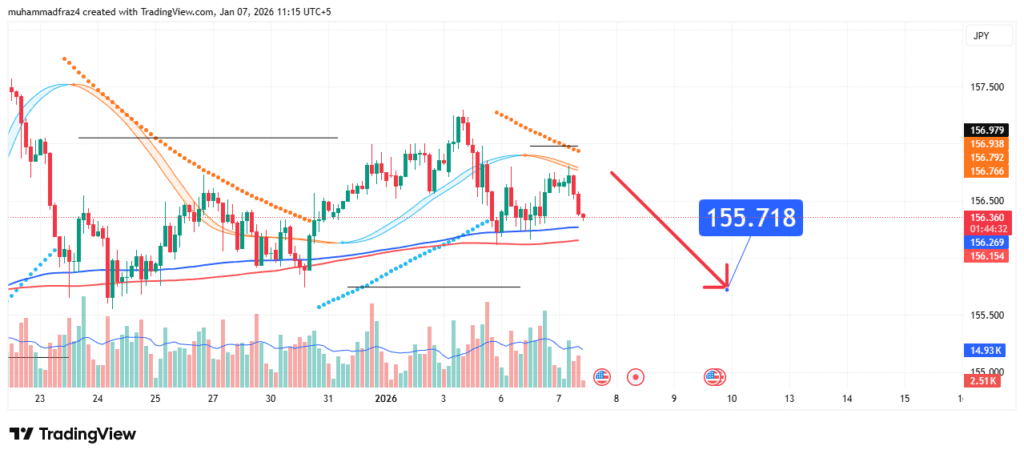
Prediction: We forecast that the price will continue its rejection from the 157.500 zone, break below the recent low near 156.154, and move towards PT1 at 155.718.
Risk Management Considerations
A professional strategy is defined by its risk management.
- Invalidation Level (Stop-Loss): The entire bearish correction thesis is invalidated if the price achieves a daily close above 157.550 (a clear break above the 157.500 double-top). This level represents a resumption of the bullish trend and a failure of the reversal pattern.
- Position Sizing: Any positions taken should be sized so that a loss triggered at the invalidation level represents a small, pre-defined percentage of your total capital (e.g., 1-2%).
Fundamental Backdrop
The technical setup is framed by the current fundamental landscape:
- Monetary Policy Divergence: The core driver remains the wide yield differential between hawkish Federal Reserve policy and the ultra-dovish Bank of Japan. Any hint of BoJ policy normalization can cause sharp Yen rallies.
- Risk Sentiment: USD/JPY often acts as a proxy for global risk appetite. A shift towards risk-aversion in markets typically benefits the safe-haven JPY.
- Intervention Risks: Japanese authorities have a history of intervening in the FX market to weaken the Yen. While levels above 150.00 are considered at risk, intervention threats can cause sudden, volatile spikes.
These factors contribute to a cautiously bearish sentiment for a technical correction, though the overarching fundamental trend may remain USD-positive.
Conclusion
USD/JPY is at a critical technical juncture following a rejection at a major high. The weight of evidence suggests a bearish corrective resolution, targeting a move to 155.718. Traders should monitor for a sustained break below 156.154 and manage risk diligently by respecting the key invalidation level at 157.550. The reaction at the target support zone will be crucial for determining whether this is a shallow correction or the start of a deeper retracement.
Chart Source: TradingView
Disclaimer: This analysis is for informational and educational purposes only and does not constitute financial advice or a recommendation to buy or sell any security. All trading and investing involves significant risk, including the possible loss of your entire investment. Always conduct your own research (DYOR) and consider seeking advice from an independent financial professional before making any trading decisions.
About the Author