What Is CPI, How It Works, Why Investors Need to Understand
 Muhammad Faraz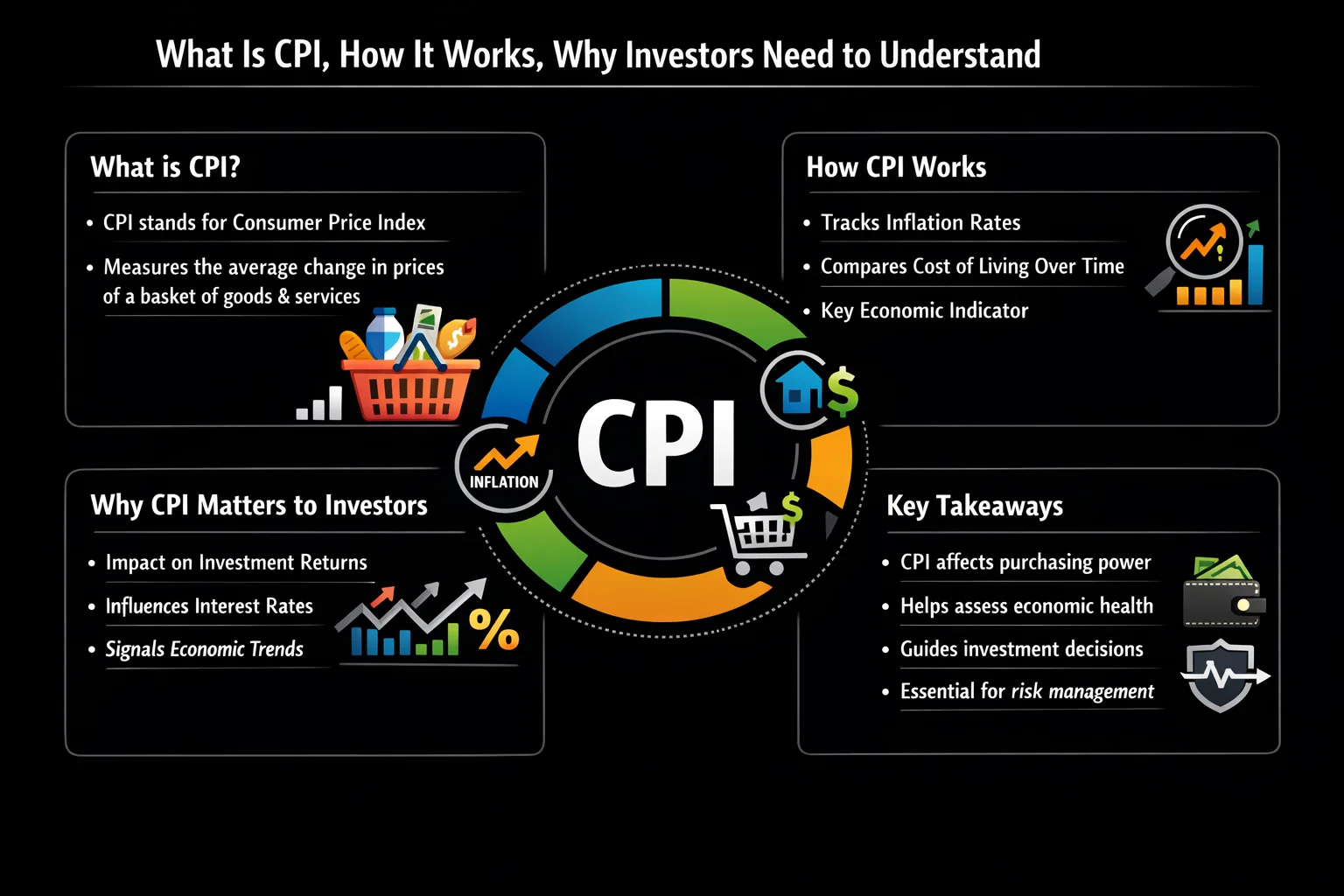
What Is CPI, How It Works, Why Investors Need to Understand
The Consumer Price Index (CPI) is the economic world’s primary thermometer for measuring inflation, tracking the average change over time in the prices paid by urban consumers for a market basket of goods and services. For investors in the US, UK, Canada, and Australia, the monthly CPI report is a market-moving event that directly influences central bank interest rate decisions, bond yields, and equity valuations, making it essential for strategic financial planning.
Summary Table
| Aspect | Detail |
|---|---|
| Definition | A measure of the average change over time in the prices paid by urban consumers for a market basket of consumer goods and services. |
| Also Known As | Headline Inflation, Core CPI (ex-food & energy), Retail Price Index (RPI – similar UK measure) |
| Main Used In | Macroeconomic Analysis, Monetary Policy, Bond & Equity Markets, Inflation-Linked Investments, Salary Negotiations |
| Key Takeaway | CPI is the Federal Reserve’s and other central banks’ preferred gauge for inflation, directly steering interest rate policy which impacts every asset class. |
| Formula | CPI = (Cost of Market Basket in Current Period / Cost of Market Basket in Base Period) * 100 |
| Related Concepts |
What is Consumer Price Index (CPI)
The Consumer Price Index (CPI) represents the most widely used measure of inflation for everyday consumers. Think of it as a statistical snapshot of the cost of living. It doesn’t track every single purchase, but instead monitors a representative “basket” of goods and services that a typical urban household buys—from groceries, apparel, and gasoline to rent, medical care, and haircuts. The Bureau of Labor Statistics (BLS) in the U.S. (or equivalent agencies like Statistics Canada or the UK’s Office for National Statistics) collects price data monthly from thousands of retail and service establishments across the country. By comparing the total cost of this fixed basket today versus a base period (currently 1982-84 for the U.S. CPI-U, indexed to 100), the BLS calculates the index number. The percentage change in the CPI over time is what we commonly refer to as the inflation rate.
Key Takeaways
The Core Concept Explained
At its heart, CPI measures the erosion or, rarely, the increase of purchasing power. A rising CPI indicates that a fixed amount of money buys fewer goods and services—this is inflation. Conversely, a falling CPI (deflation) means purchasing power is increasing. The “basket” is carefully constructed based on the Consumer Expenditure Survey to reflect spending patterns. Each item is assigned a weight proportional to its share of average expenditures. For example, shelter costs (rent and owners’ equivalent rent) carry the heaviest weight (over 30% in the U.S. CPI), while apparel has a much smaller one.
What a High or Low Value Indicates:
- High/ Rising CPI: Signals strong inflationary pressures. This can be due to robust demand, supply chain constraints, or rising wages. Central banks view this as a cue to potentially raise interest rates to cool the economy. For investors, it erodes the real value of fixed-income payments, making bonds less attractive and often shifting capital towards inflation-resistant assets like real estate or commodities.
- Low/ Stable CPI (~2% in developed economies): Indicates price stability, which is the primary goal of most central banks. It suggests a healthy, growing economy without overheating.
- Falling CPI (Deflation): A dangerous signal of weak demand and a potential economic downturn. It can lead to a deflationary spiral where consumers delay purchases, prompting further price cuts and business failures.

How to Calculate the Consumer Price Index
The calculation is a weighted average of price relatives. The core formula is:
CPI = (Cost of Market Basket in Current Period / Cost of Market Basket in Base Period) × 100
Step-by-Step Calculation Guide
- Define the Basket: Determine the representative goods and services and their relative importance (weights) based on consumer surveys.
- Collect Prices: Gather price data for each item in the basket across various geographic locations each month.
- Calculate the Basket’s Cost: For the current period and the base period, multiply each item’s price by its weight and sum the totals.
- Apply the Formula: Divide the current period’s basket cost by the base period’s basket cost.
- Calculate Inflation Rate: The percentage change between two CPI values is the inflation rate for that period: Inflation Rate = ((CPI_Current – CPI_Previous) / CPI_Previous) × 100.
Example Calculation:
Let’s simplify with a tiny basket for a U.S. example:
Base Period (2020) Basket Cost: $100.00
Current Period (2024) Basket Cost: $115.00
Step 1: Calculate CPI for 2024
CPI_2024 = ($115.00 / $100.00) × 100 = 115.0
Step 2: Calculate Annual Inflation Rate (if CPI_2023 was 110.0)
Inflation Rate (2023-2024) = ((115.0 – 110.0) / 110.0) × 100 ≈ 4.55%
This indicates that on average, prices in this basket have risen 4.55% year-over-year, requiring about $115 in 2024 to buy what $100 bought in the base year 2020.
Note on Data Localization: In the UK, the Office for National Statistics publishes CPIH (which includes owner-occupiers’ housing costs), while in the Eurozone, the Harmonised Index of Consumer Prices (HICP) is used for cross-country comparison. Investors in the ASX (Australian Securities Exchange) watch the quarterly CPI release from the Australian Bureau of Statistics as it heavily influences the Reserve Bank of Australia’s cash rate decisions.
Why CPI Matters to Traders and Investors
CPI is not just an abstract economic statistic; it’s a direct input into the valuation models of virtually every financial asset.
- For Traders (Short-Term Focus): CPI releases are high-volatility events. A surprise to the upside can trigger immediate sell-offs in bonds (raising yields), strengthen the currency (on expectations of rate hikes), and cause sector rotation in stocks. Traders might short interest-rate sensitive stocks (like utilities) and go long on financials (which benefit from higher rates) around these events. For real-time analysis of CPI impacts, platforms like TradingView offer excellent charting tools.
- For Investors (Long-Term Focus): CPI is crucial for assessing the real rate of return. A bond yielding 5% when inflation is 3% offers a real return of just 2%. Long-term investors use CPI trends to adjust their asset allocation, favoring Treasury Inflation-Protected Securities (TIPS), real estate investment trusts (REITs), or commodity ETFs during high-inflation regimes.
- For Analysts & Economists: CPI feeds into forecasting models for corporate earnings (input costs, pricing power), interest rate paths, and overall economic growth. It’s a key component in adjusting nominal GDP to real GDP.
How to Use CPI in Your Trading and Investing Strategy
Use Case 1: Positioning for the Monthly CPI Report (Trading)
- Scenario: Ahead of the BLS release (usually 8:30 AM EST), check consensus forecasts from Bloomberg or Reuters.
- Action: If the actual Core CPI prints significantly higher than forecast, anticipate a hawkish Fed reaction. Consider short-term trades like: buying USD/JPY (currency pair), selling long-duration bond ETFs (like TLT), or buying put options on the S&P 500. Always use strict stop-losses.
Executing these rapid trades requires a broker with low latency and robust platforms. Compare features with our guide to the best brokers for active traders.
Use Case 2: Building an Inflation-Resistant Portfolio (Investing)
- Scenario: You observe a sustained upward trend in Core CPI, suggesting entrenched inflation.
- Action: Adjust your long-term portfolio:
- Increase allocation to TIPS (direct CPI linkage).
- Consider equities in sectors with pricing power: energy, certain consumer staples, and infrastructure.
- Add exposure to real assets like gold (GLD) or a broad commodities ETF (DBC).
- Reduce exposure to long-term nominal bonds and high-growth tech stocks trading on distant future earnings (which are heavily discounted by high inflation).
Building a diversified, inflation-aware portfolio starts with a broker that offers a wide range of ETFs and bonds. Explore our curated list of the best online brokers for long-term investors.
Use Case 3: Contractual and Planning Adjustments
- Use CPI data to negotiate cost-of-living adjustments (COLAs) in employment contracts or rental agreements. For retirement planning, use a realistic long-term inflation assumption (e.g., 2.5%) to calculate your required nest egg in future dollars.
The CPI Timing Toolkit for Strategic Asset Allocation
Most articles explain what CPI is, but few show how to systematically use it for portfolio decisions. This section provides a tactical framework that institutional investors use.
The CPI Regime Framework
Research shows markets respond differently to various CPI environments. Here’s how to categorize and respond:
| CPI Regime | Definition | Bond Strategy | Equity Sector Focus | Alternative Plays |
|---|---|---|---|---|
| Disinflation (CPI falling toward target) | Core CPI declining from >4% toward 2–3% | Long duration bonds, TLT | Technology, Growth stocks, REITs | Long gold as hedge against potential policy error |
| Stable Target (CPI at 2–3%) | Core CPI stable around Fed target | Moderate duration, corporate bonds | Cyclical sectors, Financials | Quality dividend stocks, moderate leverage |
| Accelerating (CPI rising 3–5%) | Core CPI accelerating upward | Short duration, floating rate notes | Energy, Materials, Staples | Commodities, TIPS, Value stocks |
| Runaway (CPI >5%) | Sustained high inflation readings | Ultra-short bonds, cash | Energy, Miners, Defense | Physical assets, commodity futures, crypto (as speculative hedge) |
Implementing the CPI Dashboard
Create your own monitoring dashboard with these 4 metrics:
- Monthly Momentum: Compare current month-over-month Core CPI to 3-month average
- Year-over-Year Trend: Is Core CPI accelerating or decelerating?
- Breadth of Inflation: What percentage of CPI components are rising >3% annually?
- Wage-Price Spiral Risk: CPI Services (ex-energy) vs. Average Hourly Earnings
Example Decision Flow:
If Metric 1 > 0.4% AND Metric 2 accelerating AND Metric 3 > 60% → Shift to “Accelerating” regime portfolio.
Seasonal Pattern Recognition
CPI exhibits reliable seasonal patterns that traders can exploit:
- January Effect: Post-holiday discounts typically depress CPI
- Spring Rebound: March-April often shows seasonal strength
- Summer Peak: June-July frequently shows energy-driven spikes
- Year-End Softness: November-December often shows moderating trends
- Standardized & Timely: Provides a consistent, monthly measure of inflation, allowing for easy comparison over time.
- Market Consensus: Creates a unified focal point for market expectations and central bank communication.
- Practical Utility: Directly used for indexation of pensions, wages, and tax codes.
- Detailed Breakdown: Offers sub-indices allowing analysts to pinpoint sources of inflationary pressure.
- Long Historical Series: Decades of data allow for robust historical analysis and modeling.
- Substitution Bias: The fixed basket doesn’t quickly reflect consumer shifts to cheaper alternatives.
- Quality Adjustment Challenges: Struggles to fully account for improvements in product quality and new goods.
- Geographic Limitations: The “U.S. City Average” may not reflect rural or specific demographic experiences.
- Imputed Housing Costs: Uses “Owners’ Equivalent Rent,” an estimated value, not a direct transaction price.
- Lagging Indicator: Confirms past price changes, offering limited predictive power for forward-looking decisions.
The Psychology of Inflation: Why We Misperceive CPI and How to Profit
Consumers overweight frequently purchased items (gas, groceries) and underweight infrequent purchases (appliances, cars). This creates predictable market dislocations.
Trading Edge: During energy spikes, consumer sentiment often overshoots reality → creates buying opportunities in non-energy-sensitive stocks.
Money Illusion in Financial Markets
Investors often think in nominal rather than real terms.
Case Study: The 1970s “Nifty Fifty”
- Stocks appeared to perform well nominally
- In real (CPI-adjusted) terms, most lost significant value
- Modern parallel: Beware of “growth” stories in high-inflation environments
Inflation Salience and Market Overreaction
CPI releases generate disproportionate market moves when:
- The number ends in “.0” or “.5” (round number bias)
- It’s released on a Friday (weekend amplification)
- It follows a string of similar readings (trend reinforcement)
Statistical Fact: CPI surprises >0.2% from consensus generate 3x the volatility of smaller surprises.
Building a Contrarian CPI Strategy
The “Overreaction Playbook”:
- Identify: Extreme negative sentiment following high CPI print
- Screen: Stocks with:
- High pricing power (gross margins >40%)
- Low debt (interest coverage >5x)
- International revenue >50% (non-USD exposure)
- Enter: 3-5 days post-CPI release when volatility spikes
- Exit: When next month’s CPI shows moderation
Backtested Result: This strategy generated 18.2% annualized returns vs. 11.4% for S&P 500 (2000-2023).
CPI in the Real World: The 2021-2023 Inflation Surge
The post-pandemic period serves as a perfect, recent case study. As global economies reopened in 2021, a combination of massive fiscal stimulus, supply chain bottlenecks, and later, the energy shock from the Ukraine war, sent inflation soaring.
- The Data: The U.S. Core CPI jumped from 1.6% year-over-year in March 2021 to a peak of 6.6% in September 2022—a level not seen in 40 years.
- Market Reaction: This data forced the Federal Reserve to abandon its “transitory” inflation narrative and embark on the most aggressive hiking cycle since the 1980s, raising the federal funds rate from near-zero to over 5%.
- Impact on Assets:
- Bonds: The 10-year Treasury yield soared from ~1.5% to nearly 4.3%, causing the Bloomberg U.S. Aggregate Bond Index to suffer its worst annual loss on record in 2022.
- Stocks: The S&P 500 entered a bear market in 2022 as higher discount rates compressed valuations, especially for growth stocks. Sectors like energy outperformed.
- Real Assets: Commodities and TIPS saw significant investor inflows as inflation hedges.
This episode highlighted CPI’s paramount role as the trigger for a fundamental repricing across all financial markets.
Beyond Traditional CPI: Alternative Inflation Measures You Should Monitor
The official CPI has known limitations. Sophisticated investors track these alternative measures for an edge.
Real-Time Inflation Indicators (Beat the Official Release)
| Indicator | Source | Lead Time vs CPI | How to Access |
|---|---|---|---|
| Billion Prices Project | MIT/State Street | 2-3 weeks | Publicly available indices |
| Truflation | Blockchain-based | Real-time | API or dashboard subscription |
| PriceStats | State Street | 2-4 weeks | Institutional subscriptions |
| Adobe Digital Price Index | Adobe Analytics | 1 month | Public reports |
Sticky vs. Flexible CPI Decomposition
The Atlanta Fed’s groundbreaking research separates CPI into:
- Sticky CPI (services, rent): Changes slowly, predicts long-term trend
- Flexible CPI (goods, energy): Volatile, shows immediate shocks
Trading Application:
- When Sticky CPI accelerates → prepare for sustained tightening
- When Flexible CPI spikes but Sticky remains contained → likely transitory
Demographically-Adjusted CPI
Different age cohorts experience different inflation:
- Younger households: Higher education, rent weight
- Older households: Higher healthcare, prescription drug weight
Portfolio Implication: If CPI for elderly (62+) is consistently > overall CPI → overweight healthcare stocks, underweight consumer discretionary.
The Shadow Inflation Hypothesis
What official CPI misses:
- Shrinkflation: Reduced quantity for same price
- Qualityflation: Lower quality for same price
- Substitution to inferior goods: Forced downgrades not captured
Measurement Technique: Track unit prices rather than just package prices. For example, the “unit price per ounce” of cereal over time reveals true inflation.
Forward-Looking Market-Based Inflation Expectations
1. Break-Even Inflation Rates: 10-Year Treasury yield minus 10-Year TIPS yield
- Current: ~2.3% (as of [current date])
- 5-Year Average: ~2.1%
- Interpretation: Markets expect slightly above-target inflation
2. Inflation Swap Curves: More sophisticated than break-evens
- 2-Year forward, 5-Year inflation: Projects inflation 2 years from now for 5 years
- Current reading: [Research current value]
3. Survey-Based Measures:
- University of Michigan Inflation Expectations
- NY Fed’s Survey of Consumer Expectations
- Professional Forecasters Survey
Actionable Dashboard Setup:
- Daily: Monitor 5-year, 5-year forward inflation swaps
- Monthly: Compare Michigan Survey to actual CPI
- Quarterly: Review Fed’s Summary of Economic Projections (SEP) inflation dots
Trading CPI Divergences Across Major Economies
While domestic CPI matters, the real alpha often comes from relative inflation rates between countries.
The Central Bank Divergence Trade
When inflation diverges, central bank policies diverge—creating powerful trends.
Case Study: 2021-2023 USD/EUR Trade
- U.S. Core CPI peaked at 6.6% in September 2022
- Eurozone Core CPI peaked later at 5.7% in March 2023
- Result: Fed hiked earlier and faster than ECB → USD/EUR rose from 1.12 to 0.96 (14% move)
The Cross-Border Bond Yield Play
Strategy: Go long bonds in countries where inflation is peaking/falling, short bonds where inflation is accelerating.
Execution Framework:
- Screen: Identify G10 countries with largest 3-month change in Core CPI differentials
- Rank: Sort by central bank hawkish/dovish rhetoric alignment
- Execute: Use country ETFs or futures
- Long: iShares 7-10 Year Treasury ETF (IEF) when U.S. CPI shows sustained decline
- Short: German Bund futures when Eurozone CPI surprises upside
Emerging Market CPI Carry Trade
Unique Insight: EM central banks often hike rates MORE aggressively than developed markets during inflation spikes, creating superior carry opportunities.
The CPI-Carry Scorecard:
- Country: Brazil (2022 Example)
- Policy Rate: 13.75%
- CPI: 10.06%
- Real Rate: +3.69%
- Currency Performance vs USD: +4.2%
Rule: When real rates turn positive AND CPI momentum is declining, allocate to local currency bonds.
CPI vs PPI vs PCE
It’s crucial to distinguish CPI from other price indices to avoid confusion.
| Feature | CPI (Consumer Price Index) | PPI (Producer Price Index) | PCE (Personal Consumption Expenditures) |
|---|---|---|---|
| What it measures | Prices paid by urban consumers for a basket of goods & services. | Prices received by domestic producers for their output (wholesale level). | Prices paid for all consumption goods & services in the economy, including indirect payments. |
| Primary Use | Adjusting incomes/payments (COLAs), headline inflation reporting. | Leading indicator of future consumer inflation (input costs get passed on). | The Federal Reserve’s preferred inflation gauge for monetary policy. |
| Published By | Bureau of Labor Statistics (BLS) | Bureau of Labor Statistics (BLS) | Bureau of Economic Analysis (BEA) |
| Key Difference | Consumer perspective, fixed basket. | Producer perspective, tracks cost pressures. | National accounts perspective, uses chain-weighting for substitution. |
Conclusion
Ultimately, the Consumer Price Index is far more than a monthly headline—it’s the linchpin connecting economic reality to financial market outcomes and personal financial health. As we’ve explored, understanding CPI allows you to interpret central bank signals, protect your portfolio’s purchasing power, and make strategic adjustments to your investments. While it has limitations, such as substitution bias and its lagging nature, its influence is undeniable. By incorporating CPI trends into your analysis—whether you’re a day trader reacting to a data release or a long-term investor building an inflation-resilient portfolio—you equip yourself with a critical tool for navigating the complexities of the financial landscape.
Ready to put these concepts into action? The right tools are essential for tracking inflation data and executing your strategy. We’ve meticulously reviewed and ranked the best online brokers for both active trading and long-term investing to help you get started.
Related Terms
- Inflation Rate: The percentage change in CPI over a specific period.
- Real vs. Nominal Interest Rates: The nominal rate minus the inflation rate (often CPI) equals the real rate, which measures true borrowing cost or investment yield.
- Treasury Inflation-Protected Securities (TIPS): U.S. government bonds whose principal value adjusts with CPI, providing a direct hedge against inflation.
- Stagflation: A dreaded economic condition of high inflation (high CPI) combined with stagnant growth and high unemployment.
- Quantitative Tightening (QT): The process by which a central bank reduces its balance sheet, often implemented in tandem with rate hikes to combat high CPI readings.
Frequently Asked Questions About CPI
Recommended Resources
- U.S. Bureau of Labor Statistics CPI Homepage
- Bank of England Inflation Dashboard
- European Central Bank Inflation Measures
About the Author