What Is Index Fund, How It Work, and Why You Should Care
 Muhammad Faraz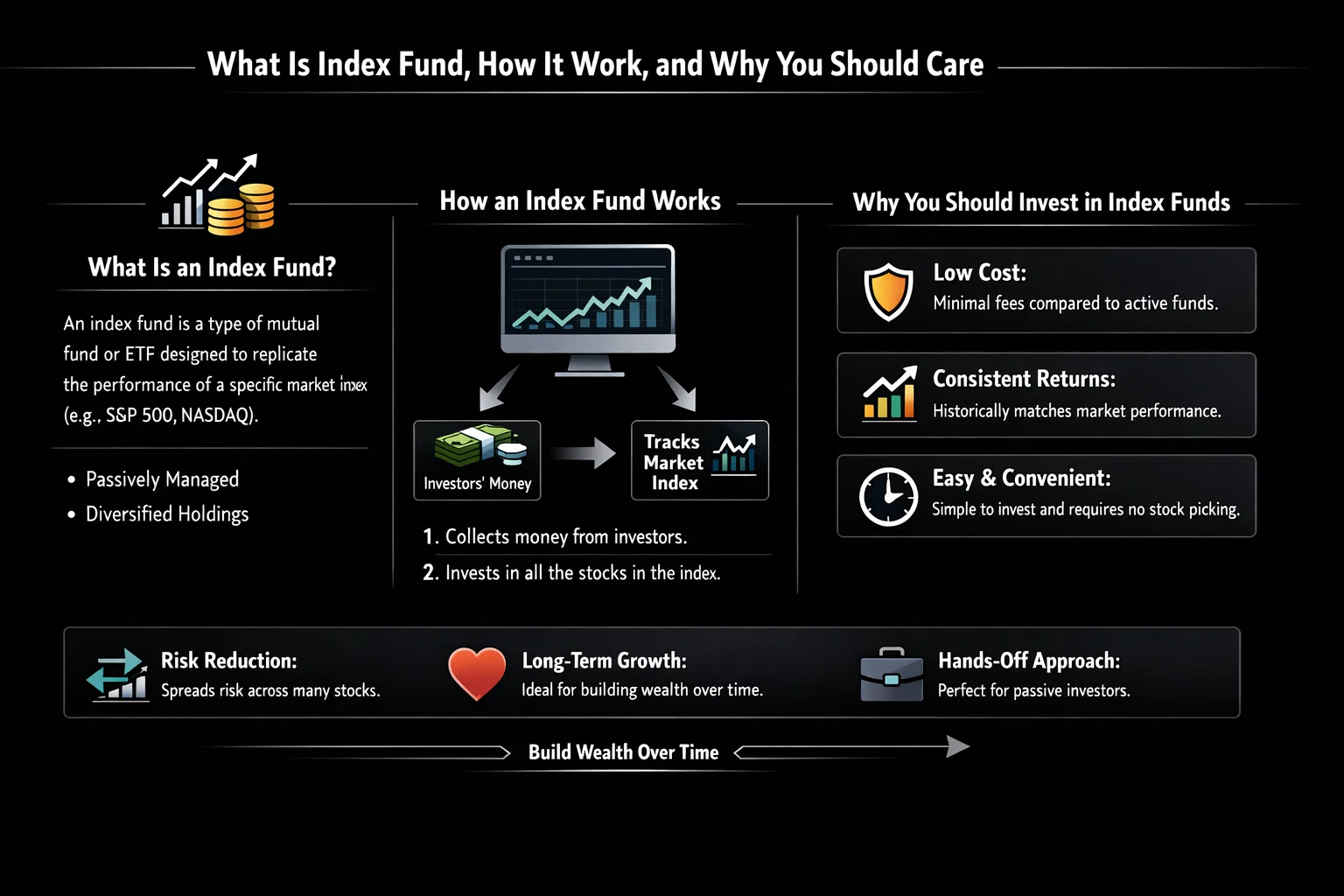
What Is Index Fund, How It Work, and Why You Should Care
An index fund is a type of mutual fund or exchange-traded fund (ETF) designed to track the performance of a specific financial market index, such as the S&P 500. By holding all or a representative sample of the securities in that index, it offers investors a simple, low-cost way to gain diversified exposure to an entire market segment. For investors across the US, UK, Canada, and Australia seeking to build long-term wealth, index funds have become a foundational tool for portfolio construction, championed by legends like Warren Buffett for their accessibility and effectiveness.
Summary Table
| Aspect | Detail |
|---|---|
| Definition | A passively managed investment fund that aims to replicate the performance of a specific market index. |
| Also Known As | Passive funds, Index trackers, Index ETFs |
| Main Used In | Long-term investing, Portfolio Management, Retirement Planning (e.g., 401(k), ISA, RRSP, Superannuation) |
| Key Takeaway | Index funds provide broad market diversification, low fees, and consistent market-matching returns, making them a core component of a prudent, long-term investment strategy. |
| Formula | N/A (Passive replication, not active selection) |
| Related Concepts |
What Are Index Funds
An index fund is a basket of securities—stocks, bonds, or other assets—that automatically mirrors the composition and performance of a pre-existing financial market benchmark, or “index.” Instead of a fund manager actively picking winners, the fund’s holdings are determined by the index’s rules. If you own a share of an S&P 500 index fund, you effectively own a tiny piece of all 500 companies in that index, from Apple to Zoom. This passive investment strategy is designed to capture the overall return of the market it tracks.
Key Takeaways
The Core Concept Explained
Think of the financial market as a vast ocean. An index, like the S&P 500, is a scientific sample of that ocean, measuring its overall temperature and movement. An actively managed fund is like a skilled sailor trying to find the fastest currents. An index fund, however, is a vessel engineered to become a perfect, miniature replica of the ocean sample itself—moving exactly as the sample does. Its performance is the market’s performance.
What It Measures & Indicates: An index fund’s value rises and falls precisely with the collective value of the securities in its underlying index. A high return indicates the targeted market segment (e.g., large US stocks, global bonds, tech companies) performed well. A low or negative return reflects a downturn in that segment. The key insight is that the fund manager’s skill (or lack thereof) is removed from the equation; you are betting on the long-term growth of an entire market or industry.
How Do Index Funds Work
Index funds use a method called passive replication. There are two primary techniques:
- Full Replication: The fund buys every single security in the index, in the exact same proportion. An S&P 500 fund using this method holds all 500 stocks.
- Sampling (Optimization): For indices with thousands of securities (like the CRSP US Total Market Index), full replication can be cumbersome. Instead, fund managers use complex algorithms to buy a representative sample of securities that closely matches the index’s risk, return, and sector characteristics.
The fund’s performance will slightly lag the index due to fees and tracking error (the small difference between the fund’s return and the index’s return). A low expense ratio and low tracking error are hallmarks of a well-managed index fund.
For investors in the US, UK, Canada, and Australia, the process is standardized through major fund providers. For example, a UK investor buying a FTSE 100 tracker from Vanguard or BlackRock’s iShares will benefit from the same passive mechanics as an American investing in an S&P 500 ETF on the NYSE.
Types of Index Funds: Beyond the S&P 500
While the S&P 500 index fund is the most famous, the universe of passive funds has exploded to cover nearly every corner of the global market. Understanding these categories helps you build a more precise portfolio.
1. Broad Market Equity Funds
These are the core building blocks for most portfolios.
- US Total Stock Market: Tracks indices like the CRSP US Total Market or Dow Jones US Total Stock Market, covering small, mid, and large-cap companies (3,000+ stocks). Examples: VTI, ITOT.
- Global/International ex-US: Provides exposure to developed and sometimes emerging markets outside your home country. Examples: VXUS (global ex-US), EFA (developed markets).
- Total World Stock: The ultimate one-fund equity solution, combining US and international in global market weights (e.g., VT).
2. Bond/ Fixed Income Index Funds
For stability and income, bond index funds are essential.
- US Aggregate Bond: The “total US bond market” benchmark (Bloomberg US Aggregate Bond Index). Examples: BND, AGG.
- Treasury & Government Bond: Focused on US government debt (e.g., VGIT for intermediate-term).
- International Bond: Diversifies interest rate and currency exposure.
3. Sector & Thematic Funds
For satellite positions or targeted exposure.
- Sectors: Technology (XLK), Healthcare (XLV), Financials (XLF).
- Thematics: Clean Energy (ICLN), Robotics & AI (BOTZ), Cybersecurity (CIBR).
4. Factor-Based (Smart Beta) Funds
These tilt toward academic factors historically associated with higher returns.
- Value: Stocks trading low relative to fundamentals (VTV).
- Growth: Companies with high earnings growth potential (VUG).
- Small-Cap: Smaller companies (VB).
- Dividend: Stocks with consistent dividend payments (VIG).
5. ESG/Sustainable Index Funds
Align investments with environmental, social, and governance criteria.
- Examples: ESGU (MSCI USA ESG Select), SUSL (MSCI USA ESG Leaders).
Choosing the right mix starts with broad-market funds for your core, then considering others for specific strategy adjustments.
For investors in Canada, look for funds tracking the S&P/TSX Composite (e.g., XIC). In Australia, the S&P/ASX 200 (e.g., IOZ) is the standard. In the UK, consider both the FTSE 100 for large caps and the FTSE 250 for mid-caps. Global providers like iShares and Vanguard offer local versions of these funds.
Why Index Funds Matter to Investors
Index funds democratize sophisticated, institutional-grade portfolio management for the everyday person.
- For Long-Term Investors: They are arguably the most efficient tool for building wealth over decades. By capturing the market’s return, which has historically trended upward, investors participate in economic growth with minimal effort and cost. They are ideal for core holdings in retirement accounts like 401(k)s, IRAs, or ISAs.
- For Risk-Averse Individuals: Diversification is the closest thing to a “free lunch” in finance. Index funds offer instant diversification, smoothing out volatility caused by any single company’s failure.
- For Financial Advisors and Analysts: They provide a low-cost, transparent building block for constructing client portfolios, allowing advisors to focus on asset allocation, financial planning, and behavioral coaching rather than stock-picking.
How to Use Index Funds in Your Investment Strategy
Use Case 1: Building a Core Portfolio (The “Boglehead” Approach)
Named after Vanguard founder John Bogle, this strategy involves using just a few broad index funds to build a globally diversified portfolio. A classic example is the “Three-Fund Portfolio”:
- A US Total Stock Market Index Fund (e.g., tracking the CRSP US Total Market Index)
- An International Stock Market Index Fund (e.g., tracking the FTSE Global All Cap ex US Index)
- A US Bond Market Index Fund (e.g., tracking the Bloomberg US Aggregate Bond Index)
You adjust the ratio (e.g., 60% stocks / 40% bonds) based on your age and risk tolerance.
Use Case 2: Satellite Tilting
Use a broad market index fund as your core (e.g., 70% of your portfolio) and use smaller allocations to sector-specific or factor-based index funds (like a technology ETF or a value stock ETF) as “satellites” to express specific market views.
Use Case 3: Dollar-Cost Averaging
Index funds are perfect for regular, automated investments. By investing a fixed amount each month, you buy more shares when prices are low and fewer when they are high, averaging out your cost over time.
To implement these strategies, you need a brokerage account with access to low-cost index funds. Choosing the right platform is crucial for minimizing costs. For a detailed comparison of brokers that excel for passive investors, including those with zero-commission ETF trading, check out our guide to the best online brokers for long-term investing.
Common Mistakes to Avoid with Index Funds
Even with a “set-it-and-forget-it” tool, behavioral errors can undermine success. Here are the top pitfalls to avoid.
Mistake #1: Chasing Performance (“Rearview Mirror Investing”)
- The Error: Buying the index fund that performed best last year (e.g., a tech sector ETF after a 40% surge).
- The Reality: Markets rotate. Last year’s winner is often next year’s laggard. This behavior leads to buying high and selling low.
- The Fix: Choose funds based on your long-term asset allocation plan, not recent returns.
Mistake #2: Overcomplicating the Portfolio
- The Error: Owning 15+ narrow index funds (e.g., separate funds for semiconductors, cloud computing, and fintech), thinking it’s more diversified.
- The Reality: This creates unnecessary complexity, overlap (many companies are in multiple sector funds), and higher overall costs without meaningful diversification benefits.
- The Fix: Adopt a minimalist approach. A Three-Fund Portfolio of US stocks, international stocks, and bonds is sufficient for most investors.
Mistake #3: Ignoring International Diversification (Home Country Bias)
- The Error: A US investor holding only S&P 500 funds, or a UK investor only in FTSE 100 trackers.
- The Reality: You’re missing nearly half of the global investment universe. Different economies and markets cycle independently, providing a smoothing effect.
- The Fix: Allocate a significant portion (20-40%) of your equity holdings to a broad international stock index fund.
Mistake #4: Forgetting About Bonds Based on Age
- The Error: A 55-year-old investor being 100% in stock index funds because “they’re safer long-term.”
- The Reality: Your time horizon isn’t just retirement; it’s also the potential need for funds before a market recovery. A severe crash could devastate a portfolio just before retirement.
- The Fix: Follow a simple rule of thumb like “110 minus your age” for stock allocation, with the rest in bond index funds. Adjust based on personal risk tolerance.
Mistake #5: Trying to Time the Market
- The Error: Moving cash in and out of an index fund based on news, fear, or predictions of a market top or bottom.
- The Reality: Consistently timing the market is impossible. Time in the market beats timing of the market. Missing just a few of the market’s best days drastically reduces long-term returns.
- The Fix: Implement dollar-cost averaging (regular, automated investments) and stick to your plan regardless of market noise.
Step-by-Step: How to Buy Your First Index Fund
Let’s make this actionable. Here is a concrete, 5-step process to go from zero to owning your first index fund.
Step 1: Define Your Goal & Timeline
- Retirement (30+ years): High allocation to stock index funds.
- House Down Payment (5-7 years): Moderate allocation to stock funds, heavier in bonds/cash.
- Education Fund (10-15 years): Balanced mix of stocks and bonds.
Write this down.
Step 2: Open a Brokerage Account
- Choose a Platform: Select a reputable, low-cost brokerage. Popular options include Fidelity, Charles Schwab, Vanguard, E*TRADE, or Interactive Brokers. In the UK, consider platforms like Hargreaves Lansdown or Vanguard UK directly.
- Account Type: For retirement, open an IRA (US) or SIPP (UK). For general investing, a standard taxable brokerage account.
- Funding: Link your bank account to transfer funds. This can take 1-3 business days.
Step 3: Select Your Specific Fund(s)
- For Your Core (Start Here):
- US Investors: VTI (Vanguard Total Stock Market ETF) or IVV (iShares Core S&P 500 ETF).
- A Simple Starter Portfolio: 100% VT (Vanguard Total World Stock ETF) gives you everything in one fund.
- Use the Fund Screener: On your brokerage platform, search for the fund ticker. Verify the Key Details:
- Expense Ratio: Should be below 0.10% for a broad fund.
- Minimum Investment: ETFs have no minimum (just share price). Mutual funds might have $1,000-$3,000 minimums.
Step 4: Place Your Order
- Order Type: Use a “Market Order” for simplicity to buy at the current price.
- For ETFs: You buy whole shares (or fractional shares if your broker offers it).
- For Mutual Funds: You specify a dollar amount.
- Review & Submit: Double-check the ticker symbol and amount before submitting.
Step 5: Set Up Automation (The Secret to Success)
- Recurring Investments: In your brokerage account settings, find the option to set up automatic, recurring investments (e.g., $500 every month into your chosen fund).
- Why This Matters: This enforces dollar-cost averaging and removes emotion. Investing becomes a boring, automated habit.
Pro Tip: Don’t stare at the price daily. Check your portfolio quarterly or annually to rebalance if needed. Your job is not to react, but to consistently add to your position over time.
Selecting the right brokerage is critical. Fees, ease of use, and access to fractional shares vary. To help you choose, we’ve compiled real-user reviews and fee comparisons in our guide to the Best Online Brokers for Beginner Investors.
- Low Cost: The single biggest advantage. Lower expense ratios mean more of your money stays invested and compounds over time.
- Diversification: Mitigates unsystematic risk with a single transaction.
- Simplicity: Easy to understand, purchase, and manage.
- Performance Consistency: While they won’t top the charts, they reliably deliver market returns, which often outpace the average actively managed fund after fees.
- Tax Efficiency: Lower turnover leads to fewer taxable events.
- No Chance to Outperform: You are guaranteed to never beat the market. In strong bull markets, some active funds may surge ahead.
- Captured in Downturns: You are fully exposed to market crashes and sector-wide declines.
- Limited Flexibility: You are tied to the index’s methodology, which may include companies you don’t approve of.
- “Average” Return: You accept the market’s average return, for better or worse.
- Overconcentration Risk: Market-cap-weighted indices can become top-heavy, with a few giant companies dominating performance.
Index Funds in the Real World: The Rise of Passive Investing
The most powerful real-world example is the decades-long shift of trillions of dollars from active to passive management. According to Morningstar, passive US equity funds surpassed active funds in total assets in 2019—a milestone that seemed unthinkable when John Bogle launched the first index fund for individual investors in 1976.
A specific case study is the performance of the Vanguard 500 Index Fund (VFIAX) versus the average large-cap actively managed fund. Over the 15-year period ending December 2023, a vast majority of active managers failed to beat the S&P 500 benchmark after fees. This persistent underperformance, highlighted in reports from S&P Dow Jones Indices (SPIVA), has been the primary engine driving investors toward low-cost S&P 500 index funds and total stock market index funds.
Index Funds vs. Robo-Advisors: Which is Right for You
Many new investors face this choice. Both use index funds, but in different ways.
| Feature | DIY Index Fund Portfolio | Robo-Advisor (e.g., Betterment, Wealthfront) |
|---|---|---|
| Control | Full control over fund selection, asset allocation, and rebalancing decisions. | Portfolio is automatically selected and managed by algorithmic models. |
| Cost | Very low — only underlying fund expense ratios (0.03%–0.15%). | Low — fund expense ratios + advisory fee (~0.25% annually). |
| Complexity | Higher — requires choosing funds, monitoring allocations, and rebalancing manually. | Very low — fully automated management and maintenance. |
| Tax Optimization | Manual — investor must identify tax-loss harvesting opportunities. | Automated tax-loss harvesting to reduce taxable gains. |
| Best For | Investors wanting maximum control, ultra-low costs, and disciplined rebalancing. | Investors wanting hands-off convenience and automated optimization. |
If you are willing to spend a few hours a year learning and managing your portfolio, a DIY approach saves on fees. If you value complete automation and behavioral guardrails (and your account is large enough for tax-loss harvesting to be valuable), a robo-advisor is an excellent, cost-effective solution. Both are far superior to traditional high-fee actively managed funds.
The Future of Index Funds: Trends and Criticisms
The rise of passive investing isn’t without debate. Understanding the evolving landscape and valid criticisms is key for an informed perspective.
Emerging Trends:
- Direct Indexing: For larger accounts ($100k+), platforms allow you to directly own the individual stocks in an index (like the S&P 500) in your own account. This enables tax-loss harvesting at the individual stock level—selling losers to offset gains—while maintaining overall index exposure. It’s like an index fund with supercharged tax benefits.
- Thematic & Active ETFs Blurring Lines: The proliferation of hyper-specific thematic ETFs (e.g., space tourism, genomics) often involves active selection criteria, challenging the pure “passive” definition.
- Zero-Cost Funds: Some providers (like Fidelity) have introduced index funds with a 0.00% expense ratio, competing on scale and using funds as loss-leaders to attract customer assets to other services.
Key Criticisms and Counterpoints:
- Criticism 1: “Passive Investing Creates Bubble-Like Concentration.” As money flows mechanically into index funds, it disproportionately boosts the largest companies in cap-weighted indices (like Apple, Microsoft in the S&P 500), potentially inflating their valuations regardless of fundamentals.
- Counterpoint: Index funds are price takers, not price makers. Active traders still set prices. The concentration reflects the actual market capitalization of successful companies.
- Criticism 2: “It Harms Corporate Governance.” With massive passive ownership through firms like BlackRock and Vanguard, a small number of fund managers wield enormous proxy voting power. Critics worry this leads to uniform, short-term, or politically motivated voting.
- Counterpoint: Passive managers have a long-term, permanent stake in companies and a strong incentive to promote sustainable governance. They often outsource voting to specialized firms and offer programs for individual investors to direct the vote of their shares.
- Criticism 3: “It Dampens Market Efficiency.” The theory holds that if everyone is passive, no one is doing fundamental research to correct mispricings, making markets less efficient.
- Counterpoint: This is a theoretical extreme. As long as the potential for profit exists, active managers and hedge funds will engage in research and arbitrage. Passive investing simply raises the bar, forcing active managers to be more skilled to justify their fees.
The Bottom Line: Index funds are evolving, not static. While valid concerns exist about market structure and governance, the core benefits of low-cost, diversified market exposure for individual investors remain compelling. The future likely holds a hybrid ecosystem where sophisticated direct indexing and thematic options coexist with classic broad-market index funds.
The trend towards direct indexing is particularly relevant for high-net-worth investors in Tier-1 countries who can benefit from complex tax strategies. If you have a portfolio over $100,000 and are interested in exploring tax-optimized direct indexing versus traditional ETFs, understanding the trade-offs is crucial.
Conclusion
Ultimately, understanding index funds empowers you to build a robust, cost-effective, and disciplined investment portfolio. While they forgo the chance of spectacular outperformance, they virtually guarantee you will not chronically underperform the market after fees—a fate that befalls most active strategies over time. By making index funds the core of your portfolio, you harness the power of diversification and compound growth, freeing you from the futile game of market timing and stock picking. Start by exploring a low-cost, broad-market index fund in your retirement account or brokerage platform as the first step toward a simpler and potentially more prosperous financial future.
Ready to put these concepts into action? The right tools are essential. We’ve meticulously reviewed and ranked the best online brokers for passive, long-term investing to help you find a platform with zero-commission trading on ETFs and robust retirement account options. Start your journey with our curated list of top-rated brokers.
How Index Funds Relate to Other Concepts
It’s crucial to distinguish index funds from similar vehicles.
| Feature | Index Fund (Passive) | Actively Managed Fund |
|---|---|---|
| Primary Goal | Match the performance of a specific index. | Outperform a benchmark index. |
| Management Style | Passive, rules-based replication. | Active, discretionary stock-picking by a manager. |
| Cost (Expense Ratio) | Very Low (often 0.03% – 0.20%). | Higher (often 0.50% – 1.50% or more). |
| Tax Efficiency | Typically High. | Typically Lower. |
| Manager Risk | None. | Significant. |
Related Terms
- ETF (Exchange-Traded Fund): Many index funds are structured as ETFs, which trade on an exchange like a stock. Not all ETFs are index funds, but most index funds for retail investors are ETFs due to their tax efficiency and tradability.
- Expense Ratio: The annual fee, expressed as a percentage of assets, charged by the fund. This is the critical cost metric for comparing funds.
- Diversification: The risk management strategy of spreading investments across various assets. Index funds are a primary tool for achieving it.
- Asset Allocation: The strategic distribution of investments across asset classes (stocks, bonds, etc.). Index funds are the ideal “building blocks” for implementing an asset allocation plan.
Frequently Asked Questions About Index Funds
Recommended Resources
- How to Build a Three-Fund Portfolio.
- U.S. Securities and Exchange Commission (SEC): Updated Investor Bulletin on Index Funds – Official guidance on risks and benefits.
- Vanguard Research: The Case for Low-Cost Index Fund Investing – Foundational white paper with supporting data.
- Bogleheads Wiki: Getting Started – A fantastic, community-driven resource for passive investors.
About the Author