How to Invest in Peer-to-Peer Lending to Earn 4-10% Returns
 Muhammad Faraz
How to Invest in Peer-to-Peer Lending to Earn 4-10% Returns
Are you tired of traditional bank savings accounts paying next to nothing? Do you want to earn higher returns by lending directly to creditworthy borrowers? This comprehensive guide will walk you through exactly how to start investing in peer-to-peer lending, from choosing platforms to building a diversified portfolio that can generate attractive passive income.
For investors in the US, platforms like LendingClub and Prosper offer regulated opportunities, while UK investors can access Funding Circle and Zopa. European investors have multiple options including Mintos and Bondora, each with different regulatory frameworks and borrower pools to consider.
Summary Table
| Aspect | Detail |
|---|---|
| Goal | Successfully invest in peer-to-peer lending to earn higher returns than traditional fixed income |
| Skill Level | Beginner to Intermediate |
| Time Required | 2-4 hours to set up, 30 minutes/month for maintenance |
| Tools Needed | Computer/smartphone, bank account, P2P platform accounts |
| Key Takeaway | Proper diversification across loans, platforms, and loan grades is crucial to managing risk while achieving target returns |
| Related Concepts |
Why Learning to Invest in Peer-to-Peer Lending is Crucial
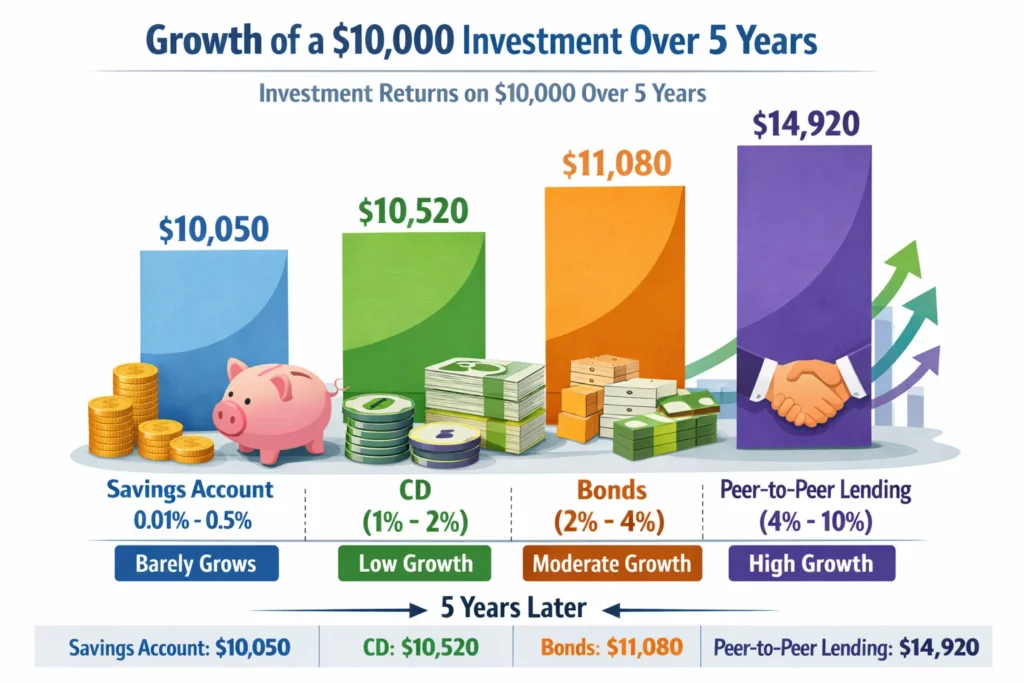
Peer-to-peer lending represents a fundamental shift in how credit works, cutting out traditional banking middlemen and connecting borrowers directly with investors. For investors, this creates opportunities for higher returns than traditional fixed-income investments while providing a new way to diversify their portfolios. According to historical data from leading platforms, investors have achieved returns ranging from 4-8% annually, significantly outpacing savings accounts and often competing with stock market returns on a risk-adjusted basis.
The problem it solves is twofold: it provides investors with an accessible source of higher-yielding fixed income, and it offers borrowers more competitive rates than traditional banks. For investors tired of microscopic savings account interest rates, P2P lending offers a tangible solution. The outcome of mastering P2P investing is the creation of a consistent passive income stream that can compound over time, potentially generating thousands in annual returns from relatively modest investments.
Key Takeaways
What You’ll Need Before You Start
Knowledge Prerequisites:
- Basic understanding of interest rates and compounding
- Familiarity with credit risk concepts
- Understanding of investment diversification principles
- Knowledge of your country’s tax treatment of interest income
Financial Requirements:
- Initial investment capital (typically $25-$1,000 minimum per platform)
- Emergency fund already established (P2P lending should not be your liquid cash)
- Long-term investment horizon (3-5 years minimum)
Tools & Platforms Needed:
- Computer or smartphone with internet access
- Bank account for transferring funds
- Government-issued ID for platform verification
- Spreadsheet software (Google Sheets or Excel) for tracking
- Access to major P2P lending platforms in your region
Before you start investing, you’ll need to choose the right platforms. Many investors begin with established platforms like LendingClub (for US investors) or Funding Circle (for UK/European investors). These platforms have proven track records and robust risk assessment systems. For a comprehensive comparison of the best P2P lending platforms, check out independent review sites like Investopedia’s guide to P2P lending platforms or Crowdwise’s platform comparisons.
What to Investigate Before Investing
Use this comprehensive checklist before depositing any funds on a P2P platform
20 points Financial Health & Stability
- +4 pts
- +4 pts
- +4 pts
- +4 pts
- +4 pts
25 points Risk Management & Underwriting
- +5 pts
- +5 pts
- +5 pts
- +5 pts
- +5 pts
20 points Transparency & Reporting
- +4 pts
- +4 pts
- +4 pts
- +4 pts
- +4 pts
15 points User Experience & Functionality
- +3 pts
- +3 pts
- +3 pts
- +3 pts
- +3 pts
20 points External Validation & Reviews
- +4 pts
- +4 pts
- +4 pts
- +4 pts
- +4 pts
Your Due Diligence Score
Interpretation Guidelines:
- 85+ points: Excellent platform – Strongly consider investing
- 70-84 points: Good platform – Suitable with proper due diligence
- 55-69 points: Average platform – Proceed with caution
- Below 55 points: Risky platform – Consider alternatives
How to Invest in Peer-to-Peer Lending: A Step-by-Step Walkthrough
Step 1: Research and Select Your Platforms
Begin by researching available P2P lending platforms in your country. Key factors to consider include:
- Platform age and track record
- Default rates and historical returns
- Fee structure (origination fees, service fees)
- Minimum investment requirements
- Secondary market availability
- Regulatory compliance and investor protections
Pro Tip: Start with just one or two platforms to learn the process before expanding. Many experienced investors recommend beginning with a smaller amount (like $500-$1,000) as a learning investment before committing larger sums.
Step 2: Complete Account Setup and Verification
Once you’ve selected your platform(s), you’ll need to:
- Create an account with your email and password
- Complete identity verification (typically requires government ID)
- Link your bank account for transfers
- Complete any required investor accreditation or suitability questionnaires
- Set up your investment preferences and auto-invest rules
Common Mistake to Avoid: Don’t skip the verification process or provide inaccurate information. This can delay your account approval or cause issues with withdrawals later.
Step 3: Develop Your Investment Strategy and Allocate Funds
This is the most critical step. Your strategy should include:
- Risk tolerance: What percentage of loans will be high-risk/high-return vs. low-risk/low-return?
- Diversification rules: How many loans will you invest in? How much per loan?
- Auto-invest settings: Criteria for automatically investing in new loans
- Reinvestment rules: What to do with repayments and interest
Formula for Maximum Per-Loan Investment:
Max Per Loan = (Total Investment Amount × Risk Tolerance %) ÷ Target Number of Loans
Example: If you have $5,000 total, want to limit high-risk loans to 20% of portfolio, and aim for 100 loans:
High-risk per loan = ($5,000 × 0.20) ÷ 100 = $10 per high-risk loan
Other loans = ($5,000 × 0.80) ÷ 100 = $40 per standard loan
Step 4: Execute Your Strategy and Monitor Performance
Begin investing according to your strategy. Most platforms offer auto-invest tools that automatically place funds into loans meeting your criteria. Key monitoring activities include:
- Track actual vs. expected returns monthly
- Monitor default rates within your portfolio
- Adjust strategy based on performance
- Reinvest repayments and interest
- Watch for platform or regulatory changes
How to Use P2P Lending Portfolio in Your Overall Investment Strategy
Scenario 1: As a Fixed Income Replacement
If you’re using P2P lending to replace bonds in your portfolio, allocate 20-40% of your fixed income allocation to P2P, keeping the rest in traditional bonds for liquidity and stability. This can boost your overall fixed income returns by 1-3% annually.
Scenario 2: As a Diversification Tool
For stock-heavy portfolios, P2P lending provides uncorrelated returns that can reduce overall portfolio volatility. Allocate 5-15% of your total portfolio to P2P lending as an alternative asset class.
Case Study: Sarah, a 35-year-old investor, allocated $20,000 (10% of her portfolio) to P2P lending across three platforms. She used a conservative strategy focusing on A-C grade loans. After three years, her P2P portfolio generated an average 7.2% annual return, significantly outperforming her bond allocation at 2.8%, while experiencing only 2.1% in defaults net of recoveries.
Common Mistakes When Investing in Peer-to-Peer Lending
Pitfall 1: Overconcentration in high-yield loans
Problem: Chasing double-digit returns by investing heavily in high-risk loans.
Solution: Limit high-risk loans to no more than 10-20% of your portfolio, regardless of tempting yields.
Pitfall 2: Insufficient diversification
Problem: Investing large amounts in just a few loans.
Solution: Follow the “100+ loans” rule – never let any single loan exceed 1% of your portfolio.
Pitfall 3: Ignoring platform risk
Problem: Putting all funds on one platform.
Solution: Spread investments across 2-4 platforms to mitigate platform-specific risks.
Pitfall 4: Underestimating illiquidity
Problem: Needing to access funds before loan terms end.
Solution: Only invest money you won’t need for 3-5 years, and utilize secondary markets where available.
Pitfall 5: Neglecting tax implications
Problem: Surprise tax bills on interest income.
Solution: Set aside 25-35% of earnings for taxes, depending on your bracket.
- Higher Returns Typically 4-10% vs 1-4% for traditional fixed income
- Portfolio Diversification Low correlation with stocks and bonds
- Passive Income Regular monthly or quarterly payments
- Accessibility Low minimum investments ($25-$100 per loan)
- Transparency See exactly who you’re lending to and why
- Default Risk Borrowers may not repay, especially in downturns
- Illiquidity 3-5 year terms with limited secondary markets
- Platform Risk Platforms can fail or face regulatory issues
- Tax Inefficiency Interest taxed as ordinary income
- Economic Sensitivity Default rates rise during recessions
Economic Cycle Strategy Guide for P2P Investors
How to adjust your P2P lending strategy through different economic phases
Economic Expansion Phase
Typical Duration: 3-5 years
✓ Recommended Actions
- Gradually increase allocation to P2P lending
- Consider slightly more aggressive loan grades (B-C)
- Expand platform diversification
- Reinvest all returns to compound growth
- Build cash reserves from other income sources
⚠️ Caution Areas
- Avoid overconcentration in any single platform
- Monitor for signs of deteriorating underwriting standards
- Watch for platform growth exceeding infrastructure
- Be wary of consistently rising default rates
- Don’t chase yields beyond reasonable risk levels
📊 Portfolio Allocation Guide
🔍 Key Indicators to Watch
- Unemployment Rate: Falling below 5%
- GDP Growth: Steady 2-3% annual growth
- Consumer Confidence: High and rising
- Platform Default Rates: Stable or declining
- Credit Spreads: Narrowing
Peak Phase (Late Cycle)
Typical Duration: 6-18 months
✓ Recommended Actions
- Begin shifting to higher quality loans (A-B grades)
- Reduce allocation to riskier platforms
- Build cash position (10-20% of P2P portfolio)
- Review and tighten auto-invest criteria
- Document all investments thoroughly
⚠️ Caution Areas
- Avoid new investments in high-risk loans
- Be cautious of platforms offering unusually high yields
- Watch for signs of platform stress
- Reduce exposure to cyclical industries
- Prepare for potential liquidity needs
📊 Portfolio Allocation Guide
🔍 Key Indicators to Watch
- Inversion of Yield Curve: Critical warning sign
- Corporate Debt Levels: Rapidly increasing
- Platform Late Payments: Rising trend
- Consumer Debt: Approaching record highs
- Central Bank Policy: Tightening cycle
Recession Phase
Typical Duration: 6-18 months
✓ Recommended Actions
- Focus on capital preservation above all else
- Invest only in highest quality loans (Grade A only)
- Maintain significant cash reserves (20-30%)
- Monitor platform stability closely
- Document all losses for potential tax benefits
⚠️ Extreme Caution Areas
- Avoid ALL new investments in risky loans
- Watch for platform failures or restrictions
- Prepare for extended illiquidity
- Be ready for collection delays
- Expect significant volatility in returns
📊 Portfolio Allocation Guide
🔍 Key Indicators to Watch
- GDP Contraction: Two consecutive quarters
- Unemployment Rate: Rapidly rising
- Platform Default Rates: Peaking pattern
- Recovery Rates: On charged-off loans
- Government Response: Stimulus measures
Recovery Phase (Early Cycle)
Typical Duration: 1-2 years
✓ Recommended Actions
- Begin gradual re-entry into quality loans
- Focus on platforms that survived the downturn
- Start with Grade A-B loans only
- Use cash reserves to buy at attractive yields
- Monitor default rates for stabilization
⚠️ Caution Areas
- Don’t rush back in too aggressively
- Watch for “zombie” platforms barely surviving
- Be cautious of extended recovery scenarios
- Monitor for double-dip recession risks
- Verify platform financial health post-crisis
📊 Portfolio Allocation Guide
🔍 Key Indicators to Watch
- Default Rates: Beginning to decline
- Economic Indicators: Turning positive
- Platform New Loan Volume: Returning to normal
- Secondary Market Activity: Increasing liquidity
- Investor Confidence: Gradual return
📋 Cycle Timing Indicators
Leading Indicators (Predict future)
- Yield curve inversion
- Building permits
- Stock market performance
- Consumer confidence surveys
- Manufacturing new orders
Coincident Indicators (Current state)
- GDP growth rate
- Industrial production
- Personal income levels
- Retail sales
- Employment levels
Lagging Indicators (Confirm trends)
- Unemployment rate
- Corporate profits
- Interest rates
- Consumer price index
- Inventory levels
Taking Your P2P Lending to the Next Level
Strategy 1: Cross-Platform Diversification
Experienced investors often use multiple platforms specializing in different loan types:
- Consumer loans (LendingClub, Prosper)
- Business loans (Funding Circle, Lendio)
- Real estate loans (Groundfloor, RealtyMogul)
- International loans (Mintos, PeerBerry)
Strategy 2: Secondary Market Trading
Some platforms offer secondary markets where you can buy and sell existing loans. This can provide:
- Early exit options for needed liquidity
- Opportunities to buy discounted loans
- Ability to rebalance your portfolio
Strategy 3: Automated Investing with Custom Criteria
Build or use automated tools that:
- Screen loans based on multiple criteria
- Automatically invest in qualifying loans
- Rebalance your portfolio based on performance
- Track tax implications automatically
External Resource: For advanced portfolio construction techniques, the book “The Peer-to-Peer Lending and Crowdfunding Guide” by Andrew Davidson provides comprehensive strategies. Online communities like the P2P Independent Forum offer real-time discussions of platform performance and strategies.
Advanced Diversification Calculator
Calculate your portfolio’s true diversification score across multiple dimensions
Your Diversification Analysis
📈 Score Breakdown
📋 Interpretation & Recommendations
GOOD Diversification
Your portfolio shows solid diversification fundamentals
✅ Strengths
- Adequate number of loans for basic diversification
- Good platform spread reduces single-platform risk
- Well-balanced loan term distribution
🎯 Areas for Improvement
- Increase loan count to 200+ for better risk distribution
- Add more loan types for better sector diversification
- Consider geographic expansion to reduce country risk
⚠️ Risk Assessment
🚀 Action Plan
Immediate Actions (This Month)
Increase auto-invest settings to target 200+ total loans
Short-term Goals (Next 3 Months)
Research and add one new loan type to your portfolio
Medium-term Strategy (6-12 Months)
Evaluate adding international exposure through global platforms
🧮 Diversification Formula
Peer-to-Peer Lending vs Corporate Bonds vs High Yield Savings vs Dividend Stocks
| Feature | Peer-to-Peer Lending | Corporate Bonds | High-Yield Savings | Dividend Stocks |
|---|---|---|---|---|
| Average Returns | 4-10% | 3-6% | 0.5-2% | 2-4% yield + growth |
| Risk Level | Medium-High (default risk) | Low-Medium | Very Low | Medium-High (market risk) |
| Liquidity | Low (3-5 year terms) | Medium (secondary market) | High (instant) | High (daily trading) |
| Income Frequency | Monthly/Quarterly | Semi-Annual | Monthly | Quarterly |
| Tax Treatment | Ordinary Income | Ordinary Income | Ordinary Income | Qualified/Ordinary |
| Minimum Investment | $25-$100 per loan | $1,000+ per bond | $0-$100 | Price of 1 share |
Conclusion
You now possess a complete framework for successfully investing in peer-to-peer lending. From platform selection to diversification strategies, you understand both the significant return potential and the real risks involved. Remember that P2P lending works best as part of a diversified portfolio, not as a standalone investment.
Start small, learn the process, track your results meticulously, and gradually scale your investments as you gain confidence and experience. The most successful P2P investors are those who approach it methodically, diversify aggressively, and maintain realistic expectations about returns and risks.
Frequently Asked Questions
Related Guides You Should Read Next:
- How to Build a Diversified Bond Portfolio
- Understanding Credit Risk in Fixed Income Investing
- How to Calculate Your True Investment Returns (Including Taxes and Fees)
About the Author